Case study · Skill
The “bibliography” and “literature watch” skills
A one-off review and a permanent feed: exhaustive PubMed search, tick-box table, legal download, filing, then one slide per reference. Two skills built one after the other, and why you need two.
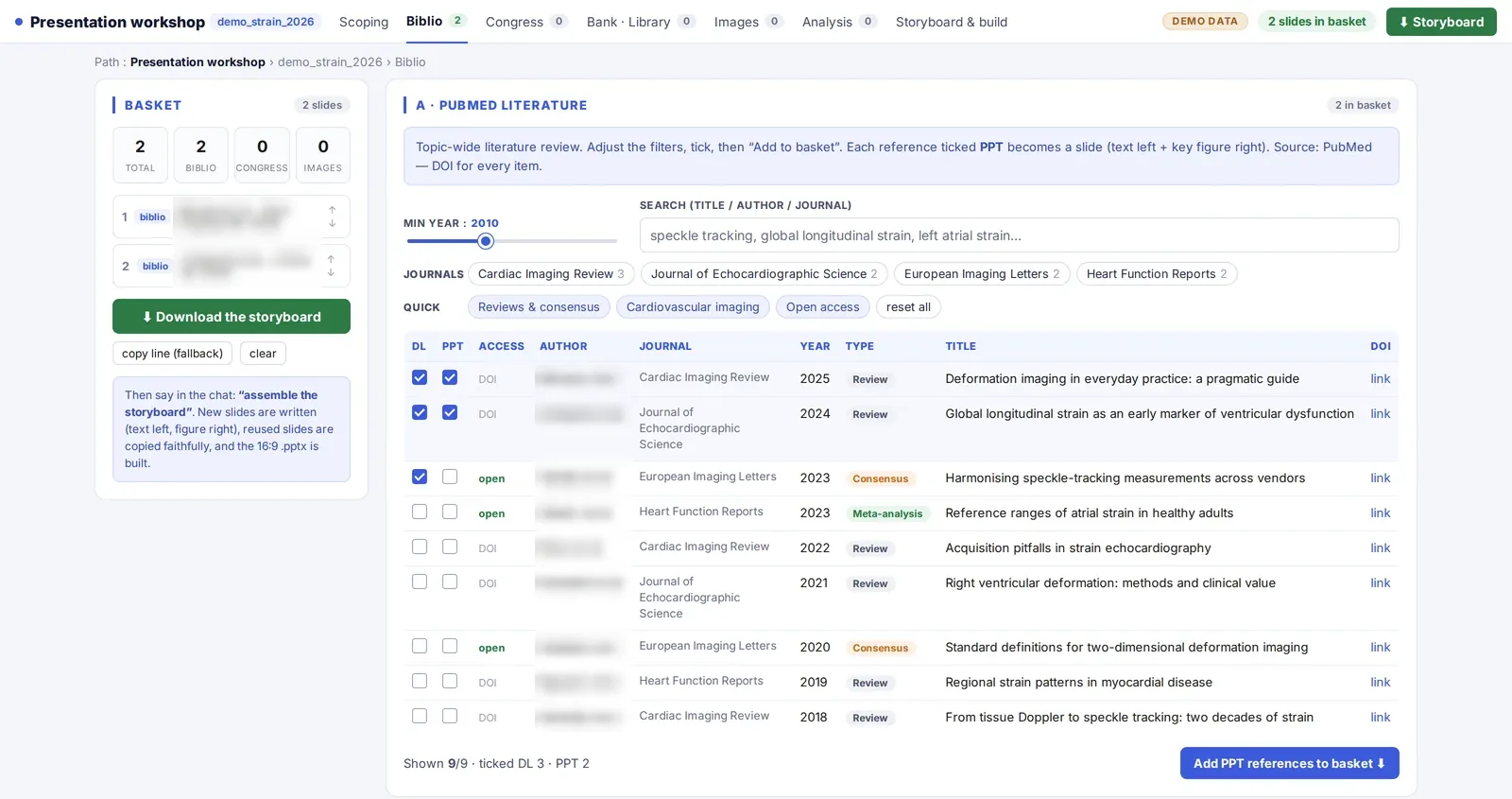
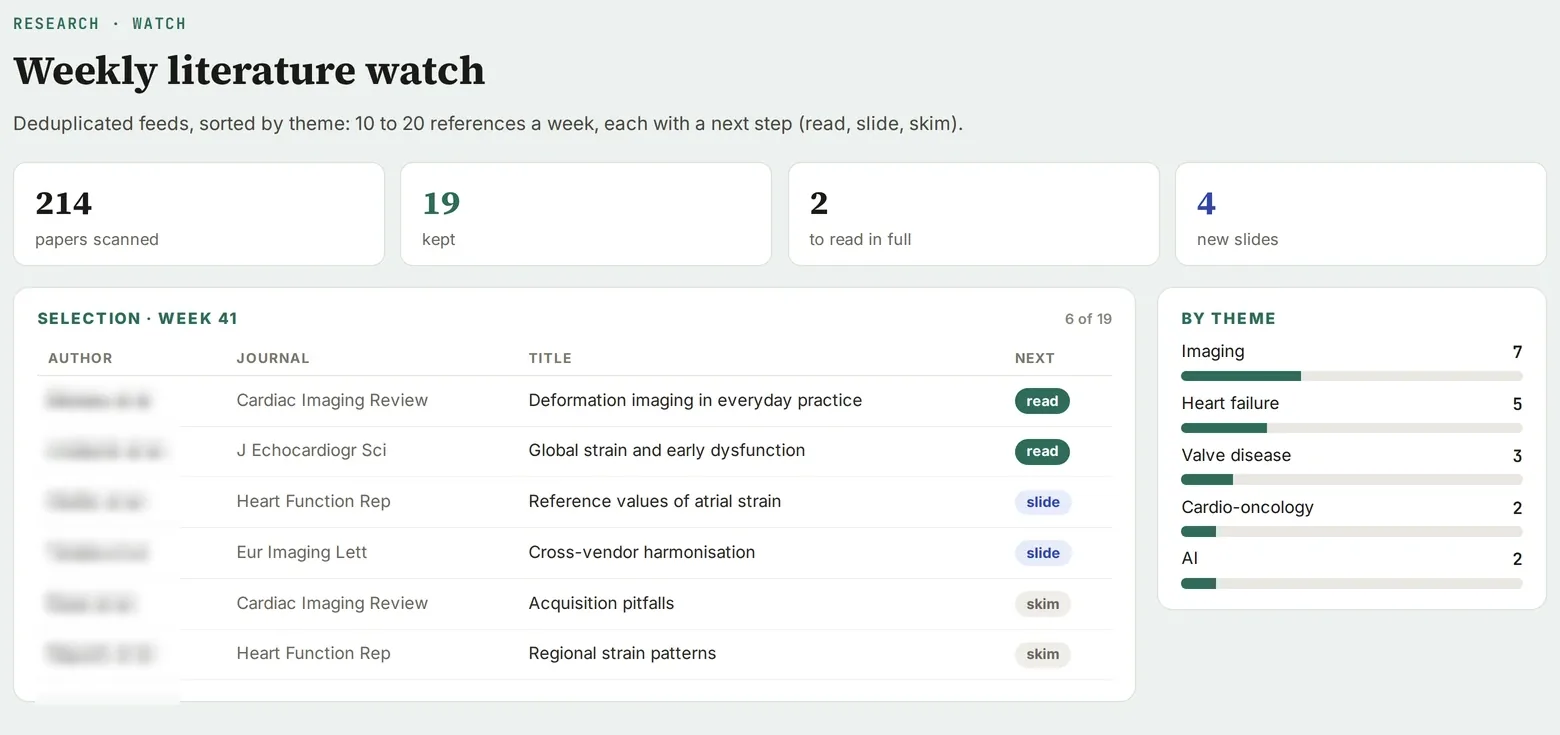
Screenshot of a real tool · fictitious data, names blurred
Idea
What problem, in one sentence?
State the two problems
“For every presentation I redo a search from scratch and re-download articles I already have.” Then, later: “I read an important article, tell myself I will make a slide of it, and never find it again.” Two problems, so two tools.
DifficultyA single skill trying to do everything (one-off review and continuous watch) mixed up folders and statuses.
SolutionSeparate them: the bibliography answers a one-off question; the watch is a feed that never runs dry.
Concept
What will the tool be, and what will it do?
Write the full bibliography cycle
Eight steps, always in this order: framing (topic and name of the review); exhaustive PubMed search (often 80 to 200 references); metadata enrichment; interactive tick-box table; retrieval of the selection; download; filing; generation of a Word document and a PowerPoint.
What to tell Claude“Carry out a literature review on [topic] and call it [short name]. Start by showing me the PubMed query and the number of results before going any further.”
!The selection step is yours; the AI offers a table, it does not choose.
Sort by quality without a magic filter
PubMed does not filter by impact factor. Quality comes from a whitelist of journals kept up to date by hand, with presets (the leading journals in the specialty, the imaging journals), and from year and journal sliders in the table.
DifficultyImpact factors “estimated” by the AI, wrong or out of date.
SolutionA persistent table of journals, updated by you once a year; the AI reads it, it does not invent it.
Build
What to ask Claude, in what order?
Build the tick-box table
A page listing the references with year, journal, access badge (open, via your institution, paywalled) and sliders. You tick; the selection goes back to Claude as a single line to paste into the conversation.
DifficultyThe selection made on the page was not passed on to Claude.
SolutionA button that produces a line of text to copy into the conversation; simple and robust.
Download legally
Open access first (open archives), then a legal version via an open-access finder service, then your university's institutional access. One batch per session. Before any download, check the local archive to make sure the article is not already there.
DifficultyDuplicates with an archive of several thousand PDFs already on the computer.
SolutionA systematic check of the archive (read-only) before downloading.
!Never bypass a paywall or a captcha.
One slide per reference
Even without a PDF: title, message, two figures actively sought in the article, short citation on the slide; abstract, DOI and PMID in the notes. Attribution to PubMed is stated once for the whole deck.
DifficultyA single figure kept “for convenience”, or a flow diagram instead of the central figure.
SolutionTwo figures required by the skill; the flow diagram is never the central figure.
Set up the watch as feeds
Three or four PubMed feeds at most: one per research theme, plus one cross-cutting feed (methods, guidelines, AI). Measure each feed's volume over a year before setting the alert; aim for about six to seven references a week in total.
What to tell Claude“Build a PubMed query for [theme] + imaging, measure its annual volume, and narrow it if it exceeds 200 references a year.”
DifficultyA feed of several hundred references a year, impossible to read.
SolutionNarrow the query before creating the alert; volume checked at every change.
DifficultyAmbiguous acronyms (two letters standing for three diseases) brought in noise.
SolutionNever a stand-alone acronym; always bounded by context. Comments, editorials, errata and retractions systematically excluded.
Test
How do you prove it works?
Check before delivering
Every reference in the final document exists (PMID checked), every figure quoted is found in the article, every file is filed in the review's folder. Discarded references remain visible with the status “discarded”.
DifficultyA cited reference that did not exist.
SolutionRule: no reference without a verified identifier; anything not found is removed.
!Never delete a discarded reference; it is archived and remains accessible.
Go live
How to deliver, publish and sustain it?
The slide straight away
The founding rule of the watch: when an article is kept, its slide is produced immediately and joins the bank. You never come back to an article “later”.
Connect to the rest of the system
The bibliography becomes a tab in the conference presentation workshop; the watch feeds the anticipation dashboard (watch tab) once a week. A synthesis layer can turn a question into an evidence table and spot what is missing from the bank.
!The evidence table is a checkpoint; nothing proceeds without your validation.