Department & care
Building a clinical case
From an anonymised discharge letter, a standard block of four slides: presentation, investigations, course, take-home message.
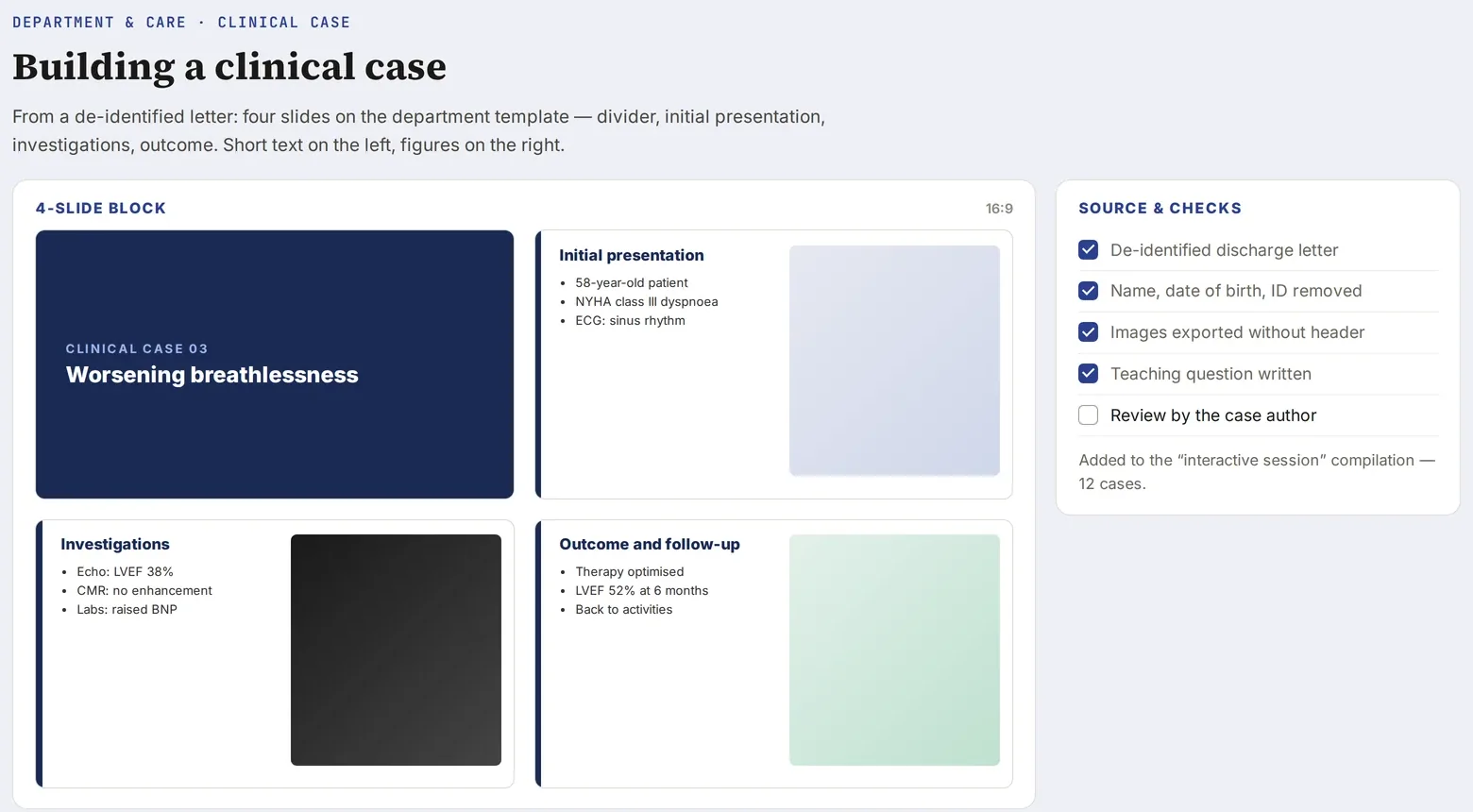
Screenshot of a real tool · fictitious data, names blurred
The problem
Clinical cases are the raw material for teaching, workshops and interactive conference sessions. Formatting them one by one, each in its own way, takes a disproportionate amount of time.
Step-by-step method
-
Anonymise first, locally: name, date of birth, identifiers, exact dates, places. Anything not needed for the clinical reasoning is removed.
-
Upload the anonymised letter (or the report, the ECG, the anonymised imaging screenshot).
-
Apply a fixed four-slide template: divider; initial presentation; investigations; course and follow-up. Telegraphic text on the left, figure on the right.
-
Compile: each new case is added to a collection (workshop, interactive session, teaching bank).
-
Write the template once into a skill, so that “build this case” is enough from then on.
-
Compile and number: a table of contents for the compilation, final numbering agreed before the event, one case per block.
-
Extrapolate nothing: a value missing from the report or unreadable on the image is marked “to be confirmed”, never inferred.
Deliverable
A consistent four-slide block, ready to be added to a compilation.
Safeguards
No identifying data is sent to the AI. If in doubt about an image (burned-in name, date), it is cropped or excluded. Check your institution’s rules on using patient data for teaching.
Starter prompt
Here is an anonymised hospital discharge letter. Build a clinical case in 4 slides (divider, presentation, investigations, course), telegraphic text on the left, figure placeholder on the right. Flag any information that still looks identifying to you.