Teaching
Preparing a thesis defence
Detect the defence at D-14, prepare the speaking notes for the supervisor or the jury president, and the report.
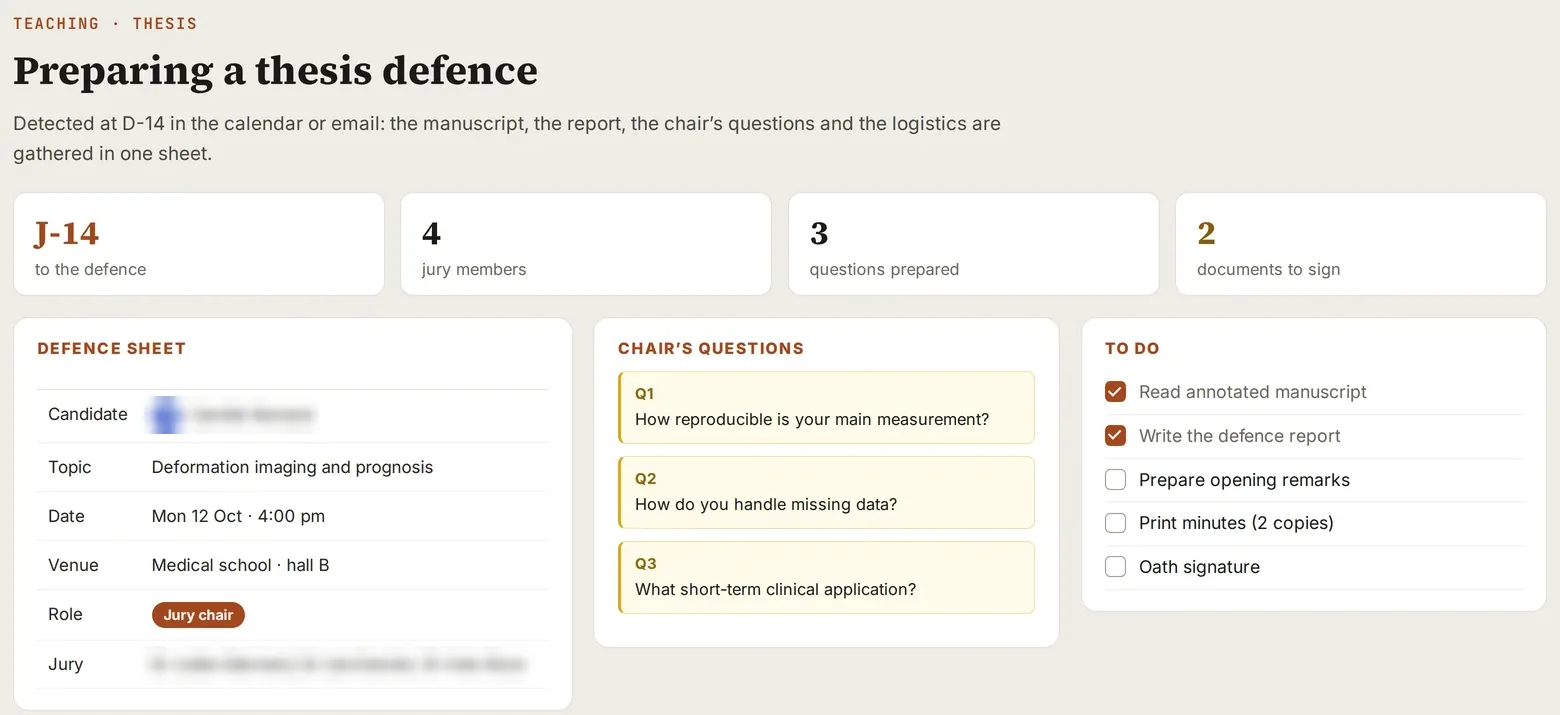
Screenshot of a real tool · fictitious data, names blurred
The problem
Supervisor, president, jury member: every defence requires reading the thesis, writing a report and preparing a few words. It is often left until the day before.
Step-by-step method
- Detect at D-14: the weekly review spots upcoming defences in the calendar and emails.
- Gather: manuscript, external examiners’ reports, the candidate’s background. The manuscript is read in chunks, and every number quoted is checked against the tables.
- Critique grid for a prognostic study or a score: population, treatments and verification bias; time zero and survival analysis; added value actually measured, not just claimed; reproducibility; internal consistency between text, tables and curves.
- Speaking notes: welcome, acknowledgements, the candidate’s background, contribution of the work, five calibrated questions (two easy, two in-depth, one opening up the subject), each followed by an “Expected: …” line summing up a good candidate’s answer. The president speaks last, so their questions tend to be about synthesis.
- Defence report: from your notes, Claude proposes a structure and a draft that you correct.
- Two note formats: full for a jury presidency; short for a jury member role, in five headings, each with its “say it out loud” line.
- Check what is missing: exact role on the jury, confirmed date, time and place (a date that differs between the calendar and the official notice is flagged), documents to bring (official record of the defence, reports).
- Reminder at D-7: the notes are ready and the documents gathered.
Deliverable
A Word sheet of about 2 pages for a jury member, 3 to 4 pages for the president, and a draft report.
Safeguards
The manuscript is unpublished work: it stays in your workspace.
Starter prompt
Here is the thesis manuscript and my reading notes. Prepare my notes as jury president: welcome, acknowledgements, background, contribution of the work, and five calibrated questions (two easy, two in-depth, one opening up the subject), each followed by an “Expected: …” line. Check every number against the tables.